Boron: The Missing Link in Vitamin D, Calcium & Hormone Balance
You can take Vitamin D, Magnesium, and Calcium—and still not get the results you expect.
Sometimes, the missing piece is not what you take, but what helps your body use it.
By Dr Catherine W. Dunne, MSc.D., RGN (GPN)
Holistic Healthcare Wexford
Boron is one of those nutrients.
It may only be required in trace amounts, but its impact on bone health, hormones, inflammation, and Vitamin D function makes it a valuable addition to a well-structured health plan.
Bone Health: More Than Just Calcium
When it comes to bones, most people think of Calcium. But Calcium alone is only part of the picture.
Boron helps the body to improve Calcium retention, enhance Magnesium utilisation, and support Vitamin D activation. This creates a more efficient system for maintaining bone density and strength.
Emerging research also suggests Boron may help reduce joint discomfort and stiffness, particularly in osteoarthritis, by supporting a balanced inflammatory response.
In clinical practice, this is often seen in patients whose bone markers or symptoms do not improve despite adequate Calcium and Vitamin D intake.
A Natural Anti-Inflammatory Support
Chronic, low-grade inflammation is at the root of many modern health concerns.
Boron has been shown to reduce inflammatory markers such as CRP, modulate immune responses, and support tissue recovery.
This makes it a useful addition in cases of joint pain, post-viral fatigue, and general inflammatory states.
In clinical settings, this may be relevant in patients presenting with persistent low-grade inflammatory symptoms.
Hormonal Balance: A Quiet Regulator
One of Boron’s most interesting roles is its influence on hormones.
It has been shown to influence free testosterone levels, support healthy oestrogen metabolism, and reduce sex hormone binding globulin (SHBG).
This means more hormones are available in their active form, which may benefit perimenopause, menopause, and low energy states.
Boron and Vitamin D: A Powerful Partnership
Boron plays a supportive role in how the body uses Vitamin D.
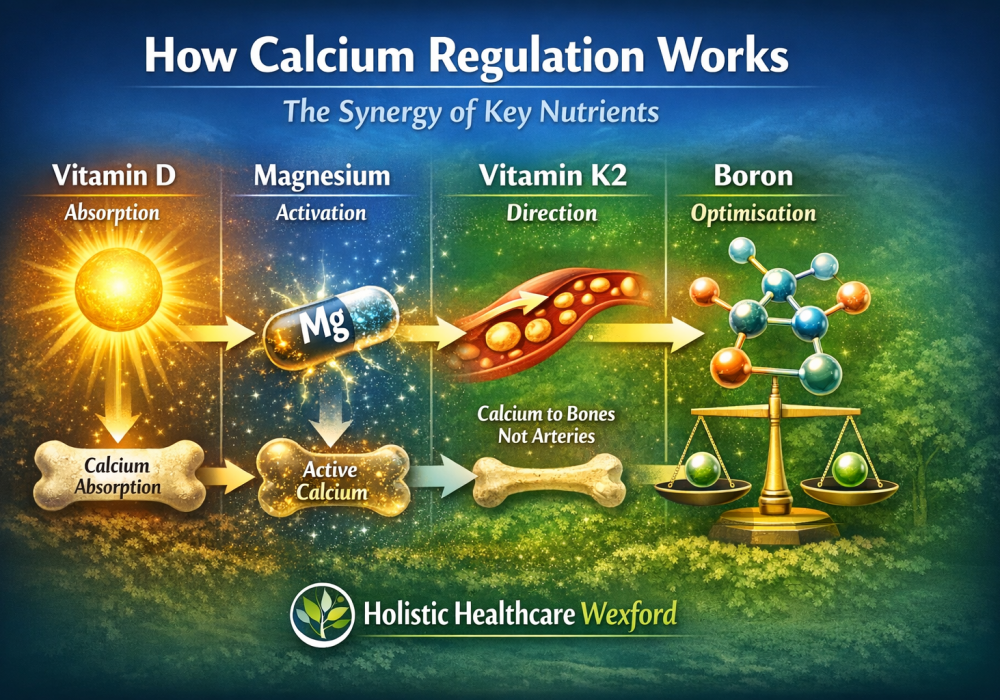
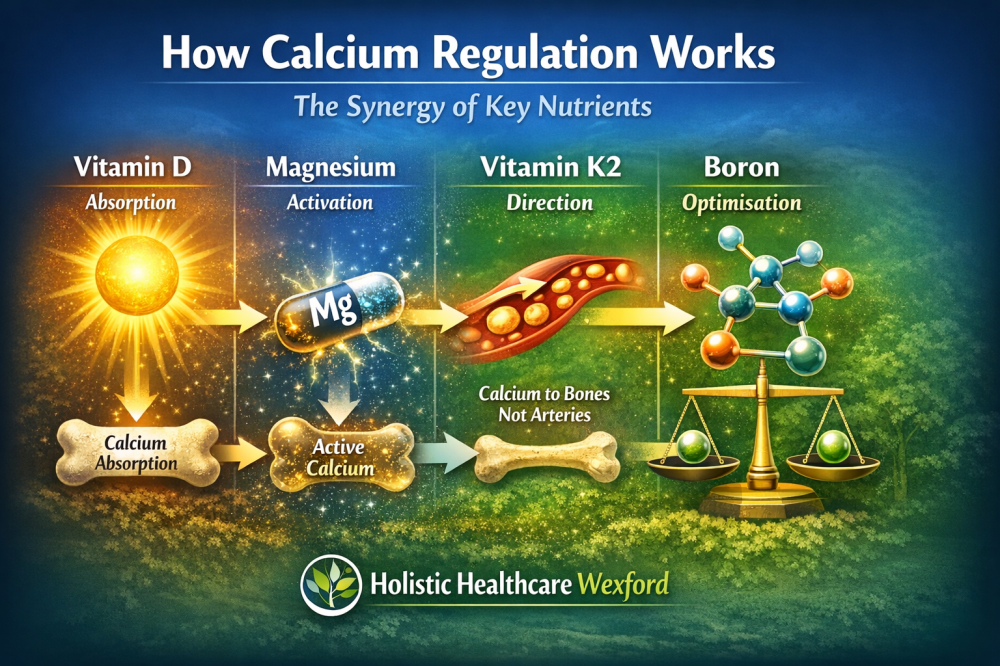
It helps extend the half-life of Vitamin D, improve Magnesium efficiency, and support proper Calcium direction alongside Vitamin K2.
Together, Vitamin D, Magnesium, Vitamin K2, and Boron create a more balanced and effective system.
Boron may also play a supportive role in thyroid function through its interaction with mineral balance and hormone regulation.
This is how these nutrients work together in the body:
Cognitive and Nervous System Support
Low Boron intake has been associated with reduced concentration, slower cognitive processing, and brain fog.
Adequate levels may support mental clarity and neurological function.
Dietary Sources of Boron
Boron is found naturally in avocados, raisins, prunes, nuts (especially almonds), and leafy green vegetables.
However, modern diets often provide lower than optimal intake.
Supplementation
Typical intake ranges from 3 mg daily for general support, with 6 mg often used in short-term therapeutic protocols.
There is rarely a need to exceed this range.
Safety Considerations
Avoid high doses in pregnancy and use caution in kidney disease. As with all nutrients, balance is key.
Clinical Perspective
Boron is often the missing link in protocols where bone support, Vitamin D response, hormonal balance, or inflammation management are not progressing as expected.
Final Thoughts
Boron helps the body use what is already there more efficiently. In many cases, health does not improve because something is missing but because what is already there is not being used properly.
Boron does not replace your core nutrients, it helps them work properly.
If you would like to understand how vitamin D, magnesium, and vitamin K2 work together to regulate calcium in the body, you can read more here:
Vitamin D3, Magnesium and Vitamin K2: The Team That Helps Calcium Work in the Body
I hope you feel inspired. Look after your body, and it will keep you healthy.
Catherine

CWD 27 March 2026/Ireland
About the Author
Dr Catherine W. Dunne MSc.D., RGN, M.H.I.T. is a nurse, holistic practitioner, and educator based in Wexford, Ireland. With over 35 years of experience in healthcare and energy-based healing modalities, she integrates conventional medical knowledge with holistic approaches to support whole-person well-being.
Catherine is the founder of Holistic HealthCare Wexford and co-founder of Aumvedas Academy, where she teaches courses in holistic health, energy medicine, and integrative healing practices.
Her work focuses on empowering people to understand the body as an intelligent system capable of healing when supported with the right knowledge, nutrition, and energetic balance.
Learn more:
Holistic HealthCare Wexford
Aumvedas Academy
Disclaimer
The information provided in this article is for educational purposes only and is not intended as medical advice. Always consult a qualified healthcare professional before starting any new supplement or health intervention.



 Holistic Healthcare Wexford