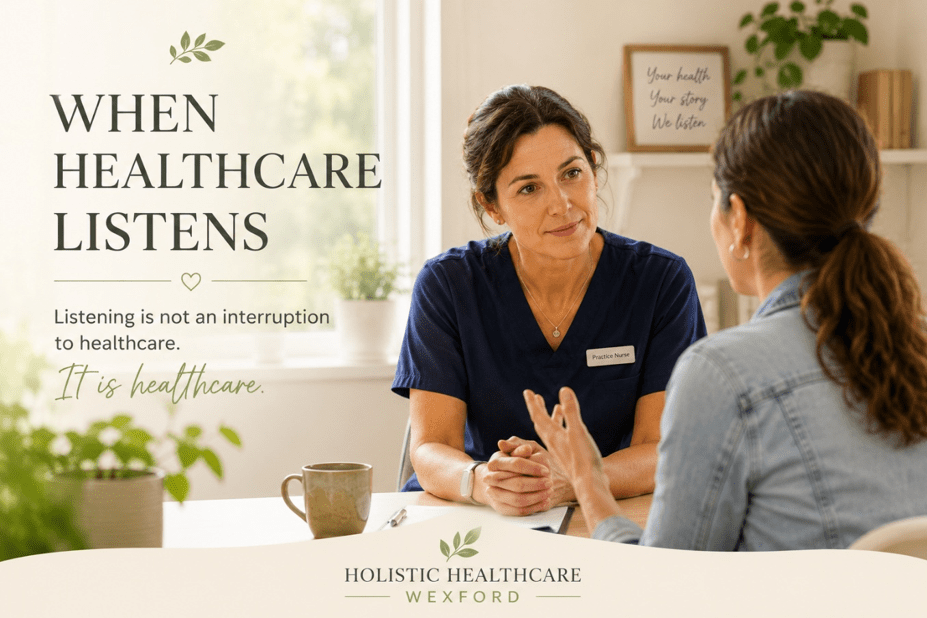
When Healthcare Listens
By Dr Catherine W. Dunne MSc.D., RGN (GPN), M.H.I.T.
There are moments in healthcare that stay with you long after the consultation has ended.
Not because of a remarkable diagnosis or a breakthrough treatment, but because of something much simpler.
Somebody chose to listen.
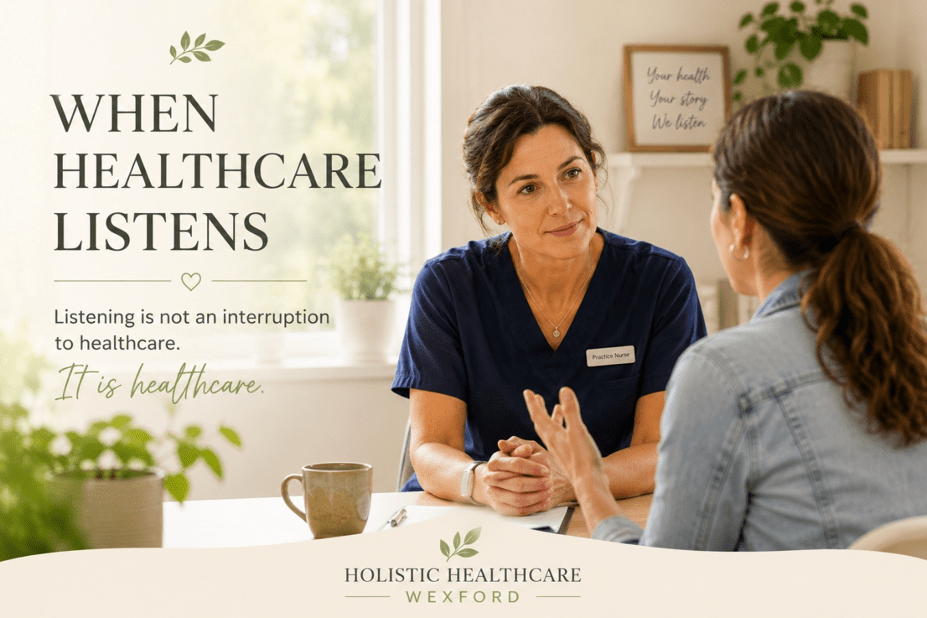
Throughout my years as a General Practice Nurse and Integrative Holistic Practitioner, I have learnt that the most important conversations rarely begin with certainty. They begin with questions.
“Tell me what you’ve noticed.”
“What worries you?”
“What else have you tried?”
“Is there anything you haven’t yet told me?”
These are not signs of uncertainty or weakness. They are signs of good clinical practice.
Over the past few weeks, I have found myself reflecting on something that has very little to do with blood tests, scans or prescriptions.
It has everything to do with listening.
As nurses, we are taught to observe. We assess, examine, investigate and document. We are also taught to question. Does this fit? Have I missed something? Is there another explanation?
Curiosity has always been one of medicine’s greatest strengths. Without it, we would never have discovered antibiotics, insulin or MRI scanners. Every advance in medicine began because someone noticed something unusual and decided it was worth asking another question.
During that time, I had the privilege of observing a patient navigate a particularly complex journey through another country’s healthcare system. The medical details are not the important part of this story. What stayed with me was something much quieter.
It was the conversations.
There were surgeons, oncologists, radiologists and specialist nurses involved. There were differing opinions and decisions that could have life-changing consequences. Yet despite the complexity of the case, one thing stood out above everything else.
People listened.
In today’s healthcare environment, that should perhaps not feel remarkable. Yet sometimes it does.
The patient openly shared every aspect of her support network, including complementary approaches that many people might hesitate to mention. What impressed me was not that every perspective was accepted, but that every perspective was heard. Nobody dismissed her. Equally, clinical decisions remained firmly grounded in scientific medicine.
Instead, the information was acknowledged, documented and placed alongside the scans, the blood tests and the clinical findings. The decisions that followed remained firmly grounded in medical evidence, yet the patient herself remained at the centre of the conversation.
That stayed with me.
Listening does not mean agreeing.
That may be one of the most misunderstood ideas in modern healthcare.
Listening is not the abandonment of science
It is not the acceptance of every explanation.
It is simply the willingness to hear another human being before deciding what comes next.
As healthcare professionals, we do not have to accept every explanation that a patient offers. Nor should we abandon critical thinking. Our responsibility is to evaluate evidence carefully and to practise safely.
But there is a profound difference between saying, “I don’t agree,” and making someone feel they cannot speak.
Patients rarely place their trust in one person alone. They seek support from spouses, friends, family, clergy, counsellors, physiotherapists, herbalists and countless others. Some pray. Some meditate. Some spend time in nature. Some simply need somebody who will sit beside them when life becomes frightening.
The question is not whether we would make the same choices.
The question is whether patients feel safe enough to tell us about them.
When they do, healthcare becomes stronger, not weaker.
Open conversations allow us to identify potential interactions, understand what motivates our patients and build relationships based on honesty rather than secrecy.
Looking back over my nursing career, I have come to realise that some of the most valuable words we can ever say are not particularly technical.
Not “I know.”
Not “You’re wrong.”
Not even “I’ve seen this before.”
Sometimes the most important words are simply:
“Tell me more.”
Those three words invite curiosity rather than judgement.
Perhaps that is where truly patient-centred healthcare begins.
Looking back over my own career, I have come to believe that patients rarely expect us to have every answer. They understand that medicine is complex and that uncertainty is sometimes unavoidable. What they hope for is something much simpler. They hope to be heard.
Perhaps that is why, after so many years in nursing, one of the comments I hear most often from patients is not “thank you for treating me”, but simply, “thank you for listening.” Every time I hear those words, I am reminded that listening is not an interruption to healthcare. It is healthcare.
Not with certainty.
But with the courage to listen.
I hope you feel inspired. Look after your body, and it will keep you healthy.
Catherine

CWD | 10 July 2026 | Ireland
Holistic Healthcare Wexford
Integrative · Mindful · Patient-Centred
About the Author
Dr Catherine W. Dunne MSc.D., RGN (GPN), M.H.I.T. is an Integrative Nurse and Holistic Practitioner based in Ireland with over 37 years of clinical experience. Her work combines evidence-informed nursing practice with holistic healthcare, education, herbal medicine and patient-centred care. She is passionate about building respectful bridges between conventional healthcare and complementary approaches while always placing patient safety, informed choice and open communication at the centre of care.
Author’s Note:
This article was inspired by a real clinical journey. To protect patient confidentiality, all identifying details, locations and contextual information have been removed or altered. The reflections shared are intended to encourage thoughtful discussion about the importance of listening within healthcare and should not be interpreted as personalised medical advice.



 Holistic Healthcare Wexford