Stinging Nettle in Spring
Simple. Powerful. Right on your doorstep.
By Dr Catherine W. Dunne, MSc.D., RGN (GPN), M.H.I.T.
Holistic Healthcare Wexford
There’s a short window in spring when stinging nettle is at its best.
The young shoots are tender, vibrant, and full of life.
They haven’t toughened yet, and interestingly, they’re far less “stingy” to handle when picked correctly.
This is when nettle shifts from being a nuisance in the garden…
to one of the most useful plants you can bring into your daily routine.
Why Spring Nettles Are Different
Young nettle leaves are rich in:
- Natural enzymes
- Vitamin C
- Iron
- Magnesium
- Calcium
- Chlorophyll
- Plant compounds that help reduce oxidative stress
At this stage, the plant is in active growth.
Everything is moving, building, and regenerating.
And that’s exactly what it offers the body.
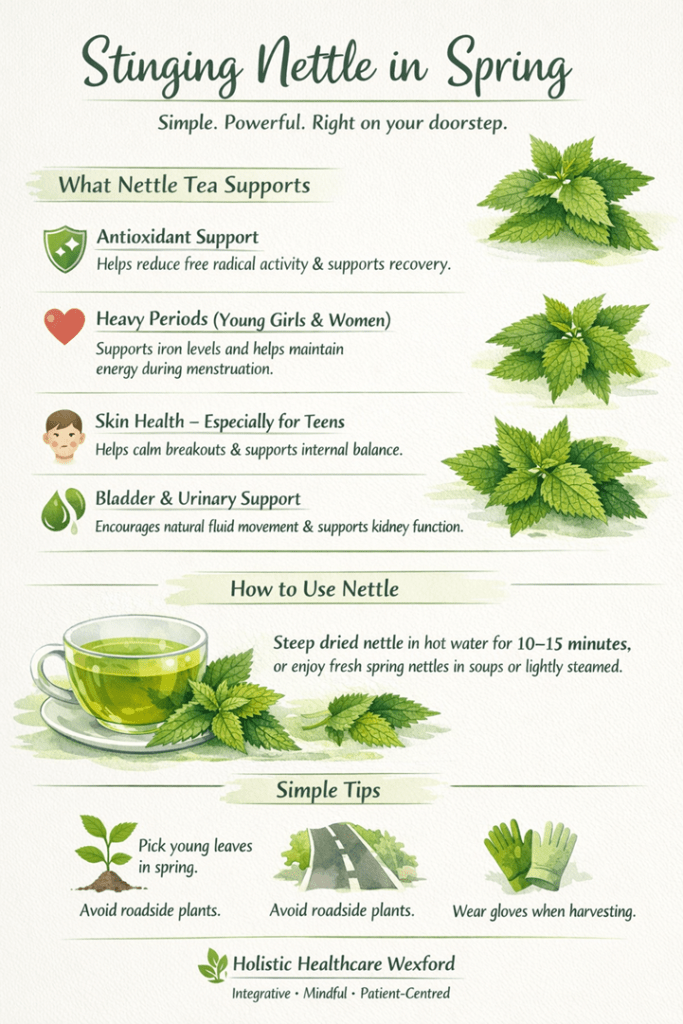
WHAT NETTLE TEA SUPPORTS
A simple cup of nettle tea, taken regularly, can do far more than most people expect.
It works quietly in the background, supporting the body where it needs it most.
Antioxidant support
Nettle helps reduce free radical activity in the body.
This matters more than people realise. Oxidative stress is linked to fatigue, inflammation, skin issues, and slower recovery.
A daily nettle tea is a quiet way of supporting the body at that level.
Support for heavy periods (young girls & women)
This is one of the old uses and still one of the most relevant.
Nettle:
- Supports iron levels
- Helps maintain energy
- Provides minerals needed during blood loss
Nettle provides natural support for iron levels, helping maintain energy during heavier menstrual cycles.
It also supplies key minerals the body draws on during blood loss.
Taken as a tea, it offers gentle support without complication.
Skin support – especially teenagers
When skin is flaring, spots, congestion, breakouts, the body is often:
- Under pressure
- Slightly inflamed
- Not clearing waste efficiently
The body often reflects internal imbalance rather than just surface issues.
Nettle supports the body by helping reduce inflammatory load, improving nutrient availability, and encouraging natural internal “clearing.”
It’s not a quick fix, but taken daily and over time, it brings a steadiness the skin responds well in a noticeable way, too.
Bladder and urinary support
Even as a simple tea, nettle supports normal kidney and urinary function.
It gently encourages fluid movement through the body without being harsh or depleting.
This makes it particularly useful when the system feels sluggish or under strain.
It’s not harsh.
It doesn’t deplete.
It supports the body in doing what it’s meant to do anyway.
How to Use It
Nettle doesn’t need complicated preparation.
In fact, its strength lies in its simplicity.
A teaspoon or two of dried nettle steeped in hot water for 10–15 minutes is enough to create a mineral-rich infusion.
Taken once or twice daily, it becomes a steady support rather than a quick intervention.
Fresh young nettle in spring can also be used in soups or lightly steamed, offering the same benefits in a more food-based form.
With nettle, consistency matters far more than quantity.
RECAP:
✔️ Fresh nettle (spring)
- Pick young tops (gloves recommended)
- Use in soups, broths, or lightly steamed
- Can also be used fresh for tea
✔️ Tea
- 1–2 teaspoons dried nettle per cup
- Steep 10–15 minutes
- Drink 1–3 cups daily
Consistency matters more than quantity.
A few practical notes
- Avoid picking near roadsides or sprayed areas
- If on diuretics or blood pressure medication, just be mindful
- Pick young leaves in spring, when the plant is at its most vibrant
- Avoid roadside or sprayed areas
- Use gloves when harvesting fresh nettle
- In most cases, nettle as a tea is safe and well tolerated
Final Thought
Nettle isn’t exotic.
It’s not expensive.
It doesn’t come in a glossy package.
And yet, every spring, it shows up offering exactly what the body often needs:
👉 nourishment
👉 support
👉 balance
Sometimes the simplest plants are the ones worth paying attention to.
I hope you feel inspired. Look after your body, and it will keep you healthy.
Catherine

CWD 03 April 2026/Ireland
Holistic Healthcare Wexford
Integrative · Mindful · Patient-Centred
About the Author
Dr Catherine W. Dunne is a Registered General Nurse with over 37 years of clinical experience in primary care in Ireland. Alongside her work in General Practice Nursing, she is the founder of Holistic Healthcare Wexford and co-founder of Aumvedas Academy.
With a background that bridges conventional medicine and holistic practice, Catherine has a particular interest in the area where patients are often told “everything is normal,” yet still feel unwell. Her work focuses on helping people understand what their body is communicating, especially in relation to energy, stress, metabolic function, and recovery.
Through a combination of clinical knowledge and holistic support, she works with individuals to restore balance, improve resilience, and support long-term wellbeing.
Based in Wexford, Ireland.
Disclaimer
The information provided in this article is for general educational purposes only and is not intended as medical advice, diagnosis, or treatment. While every effort is made to ensure accuracy, individual health needs can vary. Always consult your GP or a qualified healthcare professional before making changes to your health routine, especially if you have an existing condition, are taking medication, or are pregnant.

 Holistic Healthcare Wexford