Low Mood? Here’s Why St John’s Wort Isn’t as Simple as Many People Think

The Midsummer Flower That Holds a Secret

There is something magical about St John’s Wort.

Every year, as midsummer arrives and the days reach their longest, bright golden flowers begin to appear in gardens, hedgerows and field margins. For centuries, people have watched for its arrival, gathering it around St John’s Day and weaving it into folklore, healing traditions and seasonal celebrations.
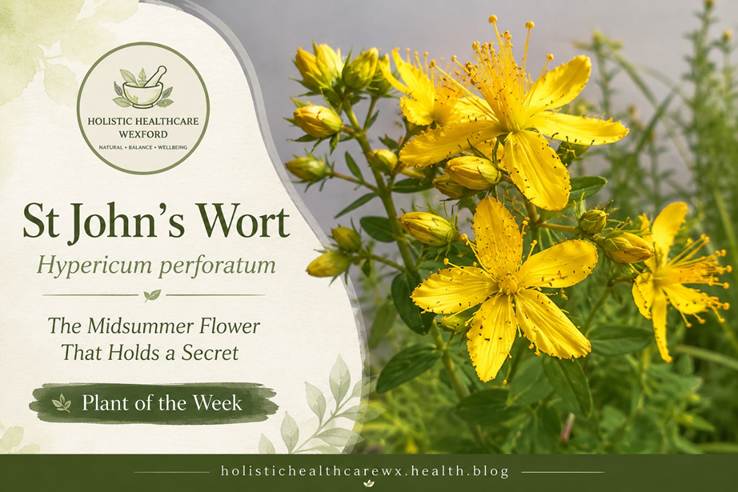
Today, many people recognise the name St John’s Wort, yet surprisingly few would recognise the plant itself.

For me, the story began with a packet of seeds.

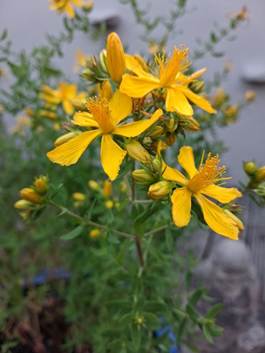
After nurturing the plants and watching them grow, there is a certain satisfaction in finally seeing the first golden flowers open. Suddenly, a plant that had existed only in books and herb guides was standing there in the garden, alive and thriving.
By Dr Catherine W Dunne MSc.D | M.H.I.T. | Registered Nurse

Meeting St John’s Wort

St John’s Wort (Hypericum perforatum) is a perennial herb native to Europe and now found throughout many parts of the world.

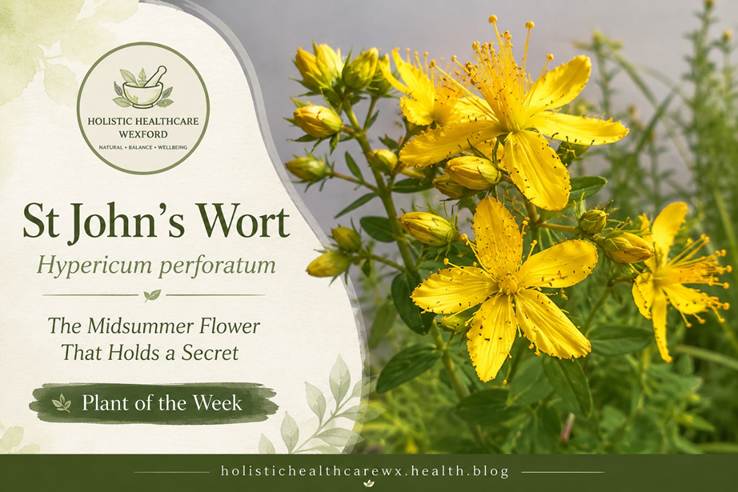
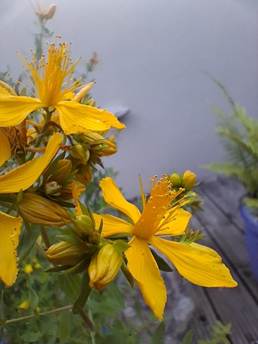
At first glance, the flowers appear simple enough: five bright yellow petals surrounding a cluster of golden stamens. Yet a closer look reveals tiny black dots scattered along the petal edges.

These dark markings are one of the plant’s distinguishing features and help with identification.
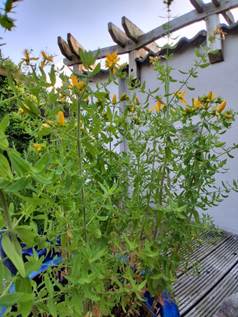
The plant itself grows upright, often reaching 60–100 cm in height. Slender stems branch freely, producing clusters of flowers throughout summer.
Why Is It Called Perforatum?

The species name perforatum means “perforated.”

Of course, the leaves are not actually full of holes.

Hold a leaf up to the sunlight, however, and hundreds of tiny translucent dots suddenly become visible. They look as though someone has carefully pierced the leaf with a fine needle.

These oil glands are one of the classic identifying characteristics of St John’s Wort.

The first time I saw them, I understood exactly why the plant had earned its botanical name.
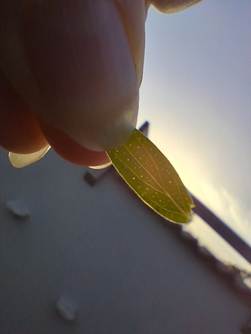
Nature often rewards those willing to look a little closer.

A Plant of Midsummer

Few herbs are more closely associated with midsummer than St John’s Wort.

Traditionally, the plant was gathered around St John’s Day on the 24th of June, close to the summer solstice. Across Europe it became associated with protection, light, vitality and wellbeing.

The timing is fitting.

Just as the sun reaches its greatest strength, the plant bursts into bloom with flowers that seem to capture that same golden energy.

Whether viewed through folklore, symbolism or simple appreciation of nature, it is difficult not to see why generations before us held this plant in such regard.

The Red Secret Hidden Within

For all its bright yellow beauty, St John’s Wort holds a remarkable secret.

Crush one of the flower buds gently between your fingers and a deep crimson-red pigment appears.

It is completely unexpected the first time you witness it.

The yellow flower suddenly produces a colour that resembles red wine or ruby oil.

For centuries this transformation fascinated herbalists and helped inspire the preparation of the famous deep-red St John’s Wort oils that are still made today.

The sight of that red staining is often the moment when people truly fall in love with the plant.

Traditional Uses

Historically, St John’s Wort has been used in many ways.

Traditional herbalists prepared oils from the flowers for external applications and created tinctures and infusions from the aerial parts of the plant.

Like many herbs with a long history of use, it carries a rich body of traditional knowledge that spans centuries.

Modern interest in St John’s Wort has brought scientific attention to the plant, but for many gardeners and herbal enthusiasts its appeal goes beyond research papers and textbooks.

Sometimes a plant earns its place simply because it is beautiful, fascinating and deeply woven into our cultural history.

Final Thoughts

Some plants impress through fragrance.

Others through flavour.

St John’s Wort captivates through curiosity.

From its golden flowers and perforated leaves to the surprising crimson pigment hidden within its buds, it continually invites us to look more closely.

This summer, if you happen to see a patch of bright yellow flowers dancing in the sunshine, take a moment to stop.

Look at the petals.

Hold a leaf to the light.

And perhaps discover for yourself why this remarkable herb has fascinated people for generations.

I hope you feel inspired. Look after your body, and it will keep you healthy.

Catherine

CWD | 24 June 2026 | Ireland

Holistic Healthcare Wexford
Integrative · Mindful · Patient-Centred

About the Author

Dr Catherine W. Dunne MSc.D. is a Registered General Nurse with over 37 years of clinical experience in primary care in Ireland. Alongside her work in General Practice Nursing, she is the founder of Holistic Healthcare Wexford and co-founder of Aumvedas Academy.

With a background that bridges conventional medicine and holistic practice, Catherine has a particular interest in the area where patients are often told “everything is normal,” yet still feel unwell. Her work focuses on helping people understand what their body is communicating, especially in relation to energy, stress, metabolic function, and recovery.

Through a combination of clinical knowledge and holistic support, she works with individuals to restore balance, improve resilience, and support long-term wellbeing.

Based in Wexford, Ireland.

Disclaimer

This article is for informational and educational purposes only and is not intended as medical advice. It does not replace consultation with a qualified healthcare professional. Patients should always seek appropriate medical guidance regarding their individual health needs and before making changes to treatment or care.

Nature’s Traditional Stomach Soother — Why Meadowsweet Was Used Long Before Antacids

The Fragrance of Summer

Long before I learned about salicylates, herbal medicine, or the traditional uses of Meadowsweet, I fell in love with its fragrance.

Every summer, as the creamy flower heads begin to open along the roadsides, ditches and damp meadows of Wexford, the air fills with a scent unlike any other native plant.

Some describe it as honey-like.

Others detect hints of almond, vanilla, or marzipan.

To me, it simply smells like summer has arrived.

Our ancestors appreciated this fragrance too. In times before air fresheners and scented candles, Meadowsweet was often gathered and brought indoors. Bundles were hung in homes, churches, and gathering places, not necessarily for drying, but simply to perfume the air. The flowers were also strewn across floors during celebrations and special occasions, releasing their sweet scent whenever they were walked upon.

It is easy to understand why.

Even today, I find myself pausing whenever I pass a stand of flowering Meadowsweet. Its perfume is unmistakable, and once recognised, it is never forgotten.

By Dr Catherine W Dunne MSc.D | M.H.I.T. | Registered Nurse

Meeting Meadowsweet

Meadowsweet (Filipendula ulmaria) is a member of the Rose family (Rosaceae) and has been treasured throughout Europe for centuries. It thrives in damp habitats, favouring meadows, ditches, riverbanks and wet roadside verges.

In Ireland, it is one of the plants that quietly announces the arrival of midsummer.

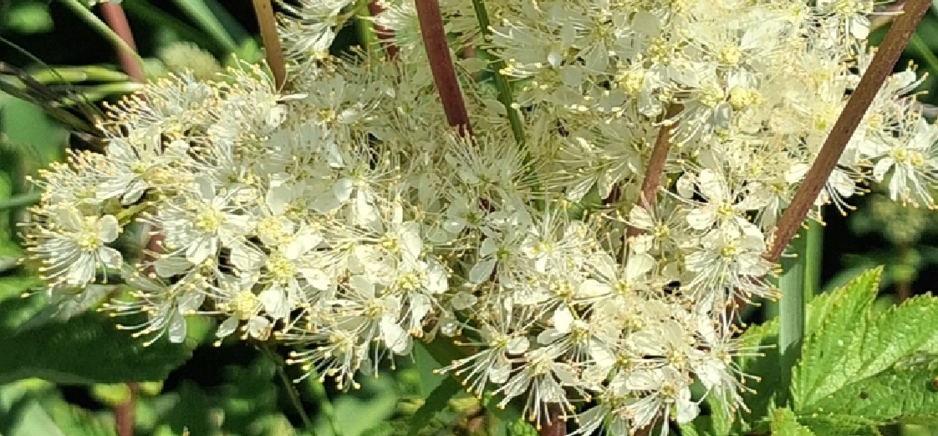
The plant grows tall, often reaching well over a metre in height. Its reddish stems support clusters of creamy-white flowers that appear almost frothy from a distance. Beneath them are deeply veined, serrated leaves that are often overlooked in favour of the spectacular blooms.

For me, Meadowsweet is one of the most recognisable wild plants of summer. Once you learn to identify it, you begin to notice it everywhere.

The Queen of the Meadow

Few wild plants have been held in such high regard as Meadowsweet.

Among Celtic peoples, Meadowsweet was considered one of the sacred herbs. It was associated with celebration, abundance and hospitality, and often featured in seasonal gatherings and ceremonies. Some traditions place it among the most revered plants of the ancient Druids, valued not only for its beauty and fragrance but also for the comfort it brought to everyday life.

Its common name reflects the habitats in which it thrives. Growing in damp meadows and along waterways, it often forms large, striking stands that seem to glow in the summer sunshine. When in full bloom, entire roadsides can become awash with creamy-white flowers, creating a spectacle that is difficult to ignore.

Meadowsweet growing along a roadside verge in County Wexford. Its sweet fragrance often reaches you before the flowers come into view.

Historically, Meadowsweet was known as a strewing herb. Before the days of modern cleaning products and air fresheners, fragrant plants were scattered across floors in homes, halls and churches. As people walked across them, the flowers released their scent into the air, helping to freshen living spaces and mask less pleasant odours.

Bundles were also gathered and hung indoors simply for their perfume. While many herbs were dried for medicinal use, Meadowsweet was often appreciated for the fragrance it brought into the home.

Standing beside a flowering patch today, it is easy to understand why our ancestors valued it so highly. The scent drifts on the breeze long before the flowers come fully into view.

Even now, whenever I harvest Meadowsweet, I find myself bringing a few stems indoors. The fragrance lingers gently in the room, connecting us to a tradition that stretches back hundreds of years.

Traditional Uses

Beyond its beauty and fragrance, Meadowsweet has a long history of medicinal use throughout Europe.

Traditional herbalists valued the flowering tops for supporting comfort during fevers, colds and seasonal illnesses. It was also widely used for digestive complaints, including indigestion, heartburn and stomach discomfort.

The herb’s gentle nature made it particularly popular as a tea. In many households, Meadowsweet was considered a comforting plant to turn to when feeling under the weather.

Historically, it was also used to support aching joints and general discomfort. Long before modern medicines existed, people relied on plants such as Meadowsweet to help ease the ordinary aches and pains of daily life.

Today, herbalists continue to appreciate Meadowsweet for many of these traditional uses, particularly in teas, tinctures and seasonal herbal preparations.

While modern science seeks to understand the compounds responsible for these effects, generations of herbal practice have already left us with a rich history of experience and observation.

The Aspirin Connection

One of the reasons Meadowsweet is so often mentioned in herbal literature is its historical connection to aspirin.

The plant contains naturally occurring salicylate compounds, and its traditional use for discomfort, fevers and aches attracted the attention of early researchers. In fact, Meadowsweet played a role in the story that eventually led to the development of aspirin as we know it today.

This connection often becomes the headline whenever Meadowsweet is discussed.

Yet I sometimes feel that focusing solely on aspirin overlooks something important.

For centuries, people valued Meadowsweet not because they understood its chemistry, but because they understood its effects. They gathered it, brewed it, shared it and passed their knowledge from one generation to the next.

The science is fascinating, but the relationship between people and this plant existed long before laboratories became involved.

As with all herbs, Meadowsweet is not suitable for everyone. People with aspirin sensitivity should avoid it, and those who are pregnant, taking medications, or living with specific health conditions should seek appropriate professional advice before use.

My Experience with Meadowsweet

Every herbalist has certain plants that earn a permanent place in their apothecary.

Meadowsweet is one of mine.

As someone who has lived with asthma for many years, respiratory infections have always commanded my respect. Like many people, I have experienced winters where a simple viral illness seemed determined to linger far longer than welcome.

It was during one such winter that I found myself returning repeatedly to Meadowsweet.

The cough was persistent.

The temperature was exhausting.

Recovery felt frustratingly slow.

During that time, Meadowsweet became one of the herbs I reached for most often. Whether taken as a tea or prepared in herbal formulations, it became a trusted companion throughout that period.

Of course, every person is different, and herbs affect individuals in different ways. What works well for one person may not suit another.

Yet some plants leave an impression that stays with you.

For me, Meadowsweet earned its place not through theory, but through experience.

It supported me during a difficult season and has remained one of the herbs I value most ever since.

Why I Continue to Harvest Meadowsweet

Each summer I find myself returning to the same roadsides and damp meadows in search of those familiar creamy flower heads.

I enjoy watching the plant’s journey from tightly packed buds to full flowering clouds of white blossoms.

I admire the rich reddish stems rising above the surrounding grasses.

I appreciate the beauty of the leaves, which are often overlooked in favour of the flowers.

Looking closely at the flowers, I was struck by how much each tiny blossom resembles a miniature Hawthorn flower. Individually delicate and easily overlooked, together they create the creamy clouds that make Meadowsweet one of the most recognisable plants of the Irish summer.


It is only when you pause and examine a flower head closely that you realise you are not looking at one flower at all, but hundreds of tiny blossoms working together.

But more than anything, I look forward to that fragrance.

The scent of freshly cut Meadowsweet is difficult to describe adequately. It is sweet without being overpowering. Delicate yet unmistakable. A fragrance that seems to belong entirely to the Irish summer landscape.

Perhaps that is why our ancestors brought it indoors.

Perhaps that is why it has remained loved for so many centuries.

And perhaps that is why, despite all the modern books, research papers and scientific explanations, I still think of Meadowsweet first as a plant that brings simple pleasure.

Some herbs earn our respect.

Others earn our affection.

Meadowsweet has earned both.

Final Thoughts

Every year, as the first flowers begin to open, I am reminded that some of the most valuable plants are often growing quietly along the roadsides we pass every day.

Meadowsweet asks for little attention.

It simply flowers, perfumes the air, supports pollinators, and continues a relationship with people that stretches back hundreds of years.

For me, it remains one of the true treasures of the Irish summer.

And each year, when that familiar fragrance drifts across a meadow or roadside verge, I know summer has truly arrived.

I hope you feel inspired. Look after your body, and it will keep you healthy.

Catherine

CWD | 24 June 2026 | Ireland

Holistic Healthcare Wexford
Integrative · Mindful · Patient-Centred

About the Author

Dr Catherine W. Dunne MSc.D. is a Registered General Nurse with over 37 years of clinical experience in primary care in Ireland. Alongside her work in General Practice Nursing, she is the founder of Holistic Healthcare Wexford and co-founder of Aumvedas Academy.

With a background that bridges conventional medicine and holistic practice, Catherine has a particular interest in the area where patients are often told “everything is normal,” yet still feel unwell. Her work focuses on helping people understand what their body is communicating, especially in relation to energy, stress, metabolic function, and recovery.

Through a combination of clinical knowledge and holistic support, she works with individuals to restore balance, improve resilience, and support long-term wellbeing.

Based in Wexford, Ireland.

Disclaimer

This article is for informational and educational purposes only and is not intended as medical advice. It does not replace consultation with a qualified healthcare professional. Patients should always seek appropriate medical guidance regarding their individual health needs and before making changes to treatment or care.

The Common Weed That Soothes Bites, Burns, Cuts and Coughs

The Humble Wayside Herb That Earned My Respect

Part of the Holistic Healthcare Wexford Herbal Medicine Library

By Dr Catherine W. Dunne, MSc.D., RGN (GPN), M.H.I.T.

There are certain plants that become more than herbs.

They become part of your story.

For me, Plantain is one of those plants.

During the Covid years, when hand disinfectants became a constant part of daily life, many healthcare workers began experiencing severe skin reactions. I was one of them.

What started as tiny blisters quickly became something much worse.

The photographs below show the progression of the skin reaction I experienced during that period, from the early blister stage through to healing and skin peeling.

The itching was intense.

The pain was extraordinary.

My hands developed clusters of fluid-filled blisters that spread across my palms. As they healed, layers of skin peeled away, leaving raw, tender tissue underneath. Simple tasks became uncomfortable. Washing my hands became an ordeal.

Like many others, I sought conventional treatment. Steroid creams were prescribed and oral steroids were tried. Unfortunately, in my case, the problem persisted.

Desperate for relief, I began researching alternatives.

That search led me to a plant that had been growing quietly around me all along.

Plantain.

I gathered fresh Ribwort Plantain leaves from the cliffs near my home, returned to my kitchen and blended them with olive oil to form a simple green mash.

Then I immersed my hands in it.

The relief was almost immediate.

The burning eased.

The itching settled.

The pain diminished.

For the first time in weeks, my hands felt comfortable.

Over the following two weeks, my skin gradually healed.

Years later, I still remember that experience every time I see Plantain growing beside a path or pushing through a crack in the pavement.

Many people see a weed.

I see one of the most useful herbs I have ever encountered.

By Dr Catherine W Dunne MSc.D | M.H.I.T. | Registered Nurse

Meeting Plantain

Plantain belongs to the genus Plantago, with two species most commonly encountered in Ireland:

  • Ribwort Plantain (Plantago lanceolata)
  • Broadleaf Plantain (Plantago major)

Both produce distinctive leaf rosettes from ground level and send up flower spikes during the growing season.

Ribwort Plantain has narrow spear-shaped leaves with prominent parallel veins.   

Broadleaf Plantain produces larger oval leaves that lie close to the ground.

Once you learn to recognise them, you begin to notice them everywhere.

A Plant That Followed Humanity

Plantain has such a close relationship with people that some Native American tribes referred to it as “White Man’s Footprint” because it seemed to appear wherever European settlers travelled.

The seeds cling easily to footwear, animals and equipment, allowing the plant to spread naturally along pathways and roadsides.

Its success lies in its remarkable toughness.

While many plants struggle in compacted soil, Plantain often thrives.

It is a survivor.

Traditional Uses

For generations, Plantain has been valued as a household remedy.

Traditional herbal uses include:

  • Minor cuts and scrapes
  • Insect bites and stings
  • Skin irritation
  • Minor wounds
  • Sore throats
  • Coughs and respiratory discomfort

A freshly crushed leaf was often applied directly to the skin as a simple field remedy when nothing else was available.

Many country children learned this long before first-aid kits became commonplace.

What Modern Herbalists Appreciate

Modern herbalists continue to value Plantain for its gentle and versatile nature.

The leaves contain a variety of naturally occurring compounds including mucilage, tannins and iridoid glycosides.

Traditionally, Plantain has been used to:

  • Support healthy skin
  • Soothe irritated tissues
  • Support respiratory comfort
  • Provide gentle digestive support
  • Calm minor irritation within the body

Its actions are generally regarded as soothing and restorative rather than stimulating.

Plantain does not force the body in a particular direction.

Instead, it offers support while the body’s own healing processes do the work.

Harvesting Plantain

The leaves are usually gathered during the growing season while young and healthy.

 Fresh leaves may be used immediately, tinctured, infused into oils or dried for later use.

In my own herbal preparations, Plantain is one of the plants I return to again and again.

It finds its way into infused oils, balms and herbal blends, earning its place through reliability rather than reputation.

Why I Grow It

The irony of Plantain is that most gardeners spend their time trying to remove it.

Meanwhile, herbalists are often quietly collecting it.

Perhaps that is part of its charm.

Plantain does not demand attention.

It does not produce spectacular flowers.

It simply grows where it is needed, surviving drought, foot traffic, poor soil and neglect.

Yet beneath this unassuming appearance lies one of the most respected herbs in traditional herbalism.

Sometimes the most valuable plants are the ones growing right beneath our feet.

Final Thought

Several years after my own experience, a patient showed me hands that looked remarkably similar to mine had during that period. She too had tried prescribed treatments with little success. I prepared a Plantain-based salve for her. Months later she returned, eager to show me the improvement. It was a reminder that sometimes the most overlooked plants can leave the deepest impression.

Do you have Ribwort Plantain or Broadleaf Plantain growing in your garden? Have you ever used it traditionally? I’d love to hear your experiences in the comments below.

I hope you feel inspired. Look after your body, and it will keep you healthy.

Catherine

CWD | 23 June 2026 | Ireland

Holistic Healthcare Wexford
Integrative · Mindful · Patient-Centred

About the Author

Dr Catherine W. Dunne MSc.D. is a Registered General Nurse with over 37 years of clinical experience in primary care in Ireland. Alongside her work in General Practice Nursing, she is the founder of Holistic Healthcare Wexford and co-founder of Aumvedas Academy.

With a background that bridges conventional medicine and holistic practice, Catherine has a particular interest in the area where patients are often told “everything is normal,” yet still feel unwell. Her work focuses on helping people understand what their body is communicating, especially in relation to energy, stress, metabolic function, and recovery.

Through a combination of clinical knowledge and holistic support, she works with individuals to restore balance, improve resilience, and support long-term wellbeing.

Based in Wexford, Ireland.

Disclaimer

This article is for informational and educational purposes only and is not intended as medical advice. It does not replace consultation with a qualified healthcare professional. Patients should always seek appropriate medical guidance regarding their individual health needs and before making changes to treatment or care.

Always Tense? The Forgotten Herb Our Grandparents Used for Stress, Headaches and Digestion

The Herb That Once Had a Remedy for Everything

There are some plants that quietly occupy our gardens without asking for attention.

Betony is not flashy. It does not produce enormous blooms or dramatic colours. Yet for centuries it was considered one of the most respected medicinal plants in Europe.

The old herbalists held Betony in such high regard that a common saying emerged:

“Sell your coat and buy Betony.”

While that may sound excessive today, it reflects the esteem in which this humble member of the mint family was once held.

Today, Betony is largely forgotten.

Yet it continues to grow faithfully in gardens, meadows and hedgerows, offering the same gentle qualities that made it a favourite of generations past.

By Dr Catherine W Dunne MSc.D | M.H.I.T. | Registered Nurse

Meeting Betony

Betony (Stachys officinalis) is a perennial herb belonging to the mint family (Lamiaceae).

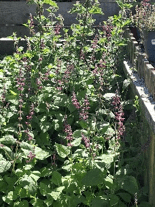
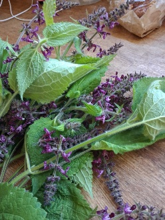
It produces upright square stems crowned with whorls of deep pink-purple flowers that bloom through summer.

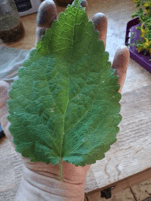
The leaves

form attractive basal clumps and are softly textured, with a slightly crinkled appearance and finely toothed margins.

Like many members of the mint family, Betony is a valuable plant for pollinators. Bees seem particularly fond of its flowers, and on warm summer days the flower spikes can be alive with activity.

In my own garden, the bees arrive almost as soon as the flowers open.

A Long History of Traditional Use

Betony has an impressive herbal history stretching back to Ancient Rome and Medieval Europe.

Traditional herbal texts describe its use for:

  • Headaches
  • Nervous tension
  • Stress and anxiety
  • Digestive discomfort
  • General weakness and fatigue
  • Minor wounds and bruises

In medieval monasteries it was considered one of the essential medicinal herbs to cultivate.

Many herbal traditions regarded Betony as both a physical and emotional tonic—supporting the body while also helping to calm an overworked mind.

What Modern Herbalists Appreciate

Modern herbalists tend to view Betony as a gentle nervine and restorative herb.

Traditionally it has been used to:

  • Encourage relaxation
  • Ease tension headaches
  • Support nervous system balance
  • Promote a sense of calm during periods of stress
  • Aid recovery during convalescence

Its action is generally considered mild rather than dramatic.

Betony is not the herb that forces change.

Instead, it works quietly in the background, helping the body find its own equilibrium.

Harvesting Betony

The aerial parts of the plant are usually gathered while flowering.

Both leaves and flowering tops can be used.

Fresh material may be tinctured, while dried herb can be prepared as a tea.

This year, my own Betony patch has flourished, producing a beautiful display of flower spikes and providing plenty of material for winter stores.

Some will be dried carefully for teas.

Some will find its way into tinctures.

And some may eventually become part of infused oils and herbal preparations.

This year my Betony has been one of the stars of the garden. The bees seem to adore it, and its flower spikes have provided colour for weeks. As I gathered some for drying, I found myself reflecting on how many generations before us would have recognised this plant immediately.

Why I Grow It

Part of the joy of growing herbs is reconnecting with plants that previous generations knew intimately.

Many of these herbs have slipped quietly from common awareness, replaced by newer remedies and modern conveniences.

Yet Betony remains exactly as it has always been.

Reliable.
Beautiful.
Bee-friendly.
And steeped in centuries of herbal tradition.

Perhaps that is why it continues to earn a place in my garden.

Not because it shouts for attention.

But because, like many of the best herbs, it simply gets on with the job.

Have you ever grown Betony in your garden, or encountered it in the wild? I’d love to hear about your experiences in the comments below.

I hope you feel inspired. Look after your body, and it will keep you healthy.

Catherine

CWD | 22 June 2026 | Ireland

Holistic Healthcare Wexford
Integrative · Mindful · Patient-Centred

About the Author

Dr Catherine W. Dunne MSc.D. is a Registered General Nurse with over 37 years of clinical experience in primary care in Ireland. Alongside her work in General Practice Nursing, she is the founder of Holistic Healthcare Wexford and co-founder of Aumvedas Academy.

With a background that bridges conventional medicine and holistic practice, Catherine has a particular interest in the area where patients are often told “everything is normal,” yet still feel unwell. Her work focuses on helping people understand what their body is communicating, especially in relation to energy, stress, metabolic function, and recovery.

Through a combination of clinical knowledge and holistic support, she works with individuals to restore balance, improve resilience, and support long-term wellbeing.

Based in Wexford, Ireland.

Disclaimer

This article is for informational and educational purposes only and is not intended as medical advice. It does not replace consultation with a qualified healthcare professional. Patients should always seek appropriate medical guidance regarding their individual health needs and before making changes to treatment or care.

Self Heal (Prunella vulgaris): The Humble Lawn Herb with Extraordinary Potential

Part of the Holistic Healthcare Wexford Herbal Medicine Library

By Dr Catherine W. Dunne, MSc.D., RGN (GPN), M.H.I.T.

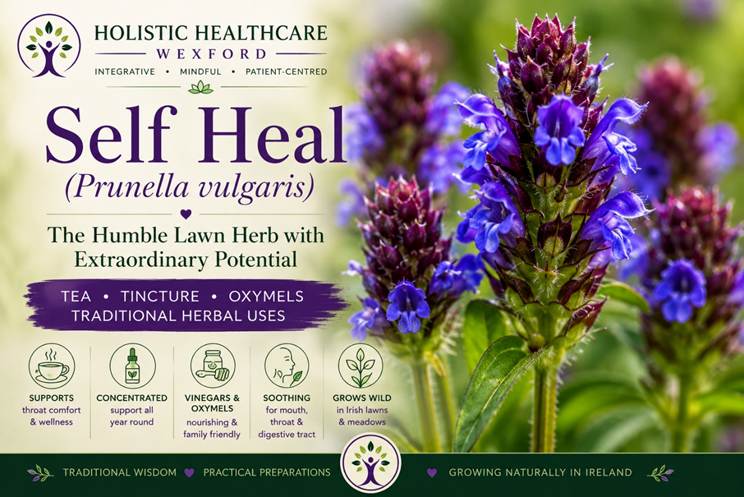
Walk through almost any wildflower meadow or unmown lawn in Ireland during summer and you may find a small purple flower quietly growing beneath your feet. Known as Self Heal, Heal-All, or Carpenter’s Herb, Prunella vulgaris has earned a reputation over centuries as one of nature’s most versatile healing plants.

Despite its modest appearance, Self Heal has been valued in traditional European, Chinese, and Native American herbal medicine for generations.

A Plant with a Long History

The common name “Self Heal” reflects the herb’s traditional reputation for supporting the body’s natural restorative processes. Historically, it was used both internally and externally for wounds, sore throats, digestive complaints, and periods of convalescence following illness.

Traditional herbalists often regarded Self Heal as a herb that helped restore balance when the body was under stress or recovering from physical challenges.

Modern Interest in Prunella

Modern research has identified a range of naturally occurring compounds within Prunella, including:

  • Rosmarinic acid
  • Flavonoids
  • Tannins
  • Triterpenes
  • Polysaccharides

These compounds are being studied for their antioxidant, soothing, and immune-supportive properties.

While research continues, traditional use remains one of the strongest guides to understanding this remarkable plant.

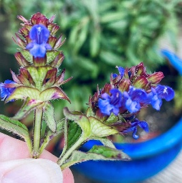
How to Recognise Self Heal

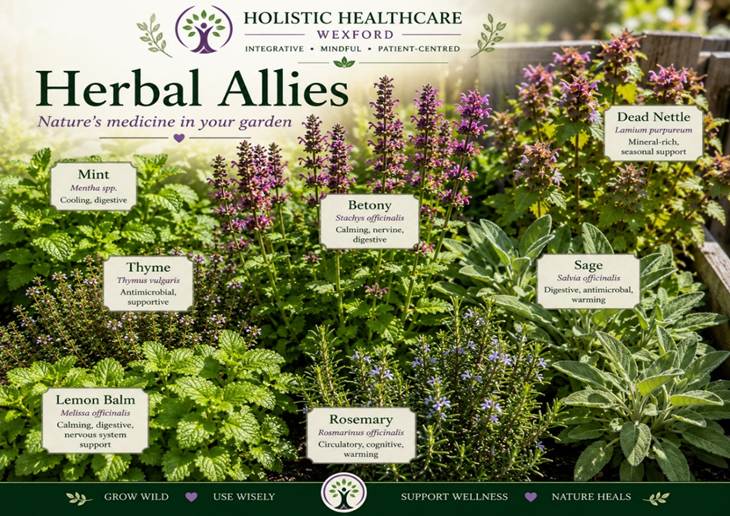
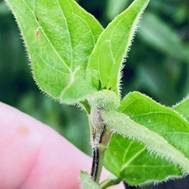
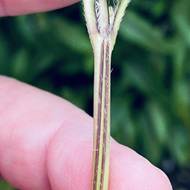
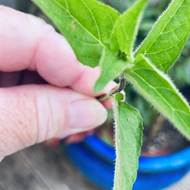
Self Heal belongs to the mint family (Lamiaceae), a large family of plants that includes familiar herbs such as Mint, Thyme, Sage, Lemon Balm, Rosemary, Betony, Ground Ivy and Dead Nettle. While many mint-family plants are aromatic, others such as Self Heal and Dead Nettle have little noticeable scent but still display the family’s characteristic square stems and opposite leaves.

Like many members of the mint family, Self Heal displays several distinctive characteristics:

  • A square stem rather than a round stem
  • Opposite pairs of leaves growing directly across from each other
  • Fine hairs on the stems and leaves
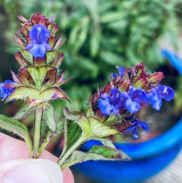
  • Purple or reddish tinges on stems and flower bracts
  • Dense flower heads formed from stacked bracts

The flowers are typically blue-violet to purple and emerge from a compact, cone-like flowering head. As the flowers open, they appear in rings around the flower spike, creating the distinctive appearance that makes Self Heal easy to recognise once in bloom.

The leaves are oval to lance-shaped with gently toothed margins and are usually slightly hairy. Young plants can look quite different from mature flowering specimens, often appearing as low-growing clusters of leaves before sending up flowering stems.

Self Heal commonly grows in lawns, meadows, field margins, pathways, and other grassy areas throughout Ireland. It often thrives where mowing is infrequent, creating beautiful patches of purple flowers during summer.

Once you learn to recognise the square stems, opposite leaves, and distinctive flower heads, you may be surprised to discover how often Self Heal has been growing unnoticed beneath your feet.

Self Heal as a Tea

One of the simplest ways to use Self Heal is as an herbal tea.

Traditionally enjoyed for:

  • Sore throats and hoarseness
  • Mouth and gum comfort
  • Digestive upset
  • Seasonal wellness
  • General convalescence and recovery

The dried flowering tops and leaves make a mild, pleasant tea that combines well with:

  • Plantain
  • Betony
  • Lemon Balm
  • Meadowsweet
  • Thyme

For many herbalists, Self Heal tea is a valuable addition to the winter medicine cupboard.

Self Heal as a Tincture

Fresh or dried flowering tops can be extracted in alcohol to create a tincture.

Traditional uses include:

  • Supporting normal immune function
  • Swollen glands and throat discomfort
  • Seasonal challenges
  • General constitutional support

A tincture offers a concentrated preparation and provides a convenient way to use the herb throughout the year.

Self Heal in Vinegars and Oxymels

Self Heal No photo description available.combines beautifully with apple cider vinegar and honey.

An oxymel containing Self Heal, Thyme, Plantain, and seasonal herbs has traditionally been used to support:

  • Winter wellness
  • Throat comfort
  • Respiratory health
  • Family immune support

The addition of honey makes this preparation especially suitable for children and those who dislike herbal teas.

External Uses

Traditionally, Self Heal was used externally as:

  • A wash for minor skin irritations
  • A compress for cuts and abrasions
  • A soothing rinse for the mouth and throat

These uses contributed greatly to the herb’s reputation as a “heal-all” plant.

Harvesting Self Heal

The best time to harvest Self Heal is when the flower heads are fully developed and actively flowering.

Harvest on a dry day after the morning dew has evaporated.

The flowering tops can be:

  • Dried for tea
  • Tinctured fresh
  • Added to vinegars
  • Used in oxymels
  • Infused into oils

Self Heal for Hoarseness, Reflux and Recovery

One of the most interesting modern uses of Self Heal may be in supporting irritated tissues of the mouth, throat, and upper digestive tract.

Many people experience symptoms such as:

  • Persistent throat clearing
  • Hoarseness
  • A burning sensation behind the breastbone
  • A feeling of throat irritation despite normal investigations
  • Lingering throat sensitivity following viral illnesses

Traditionally, herbalists often turned to soothing and restorative herbs when tissues appeared irritated or inflamed.

Self Heal combines particularly well with:

  • Plantain (Plantago spp.)
  • Betony (Stachys officinalis)
  • Thyme (Thymus vulgaris)

Together these herbs create a gentle tea traditionally used to support throat comfort and general respiratory wellbeing.

While Self Heal is not a replacement for medical assessment or prescribed treatment, many people find herbal teas containing these plants offer a soothing and supportive addition to their overall care plan.

Traditionally, Self Heal has also been valued as a restorative herb during periods of convalescence, particularly when the throat, mouth, or upper digestive tract remain sensitive following illness.

Why Self Heal Has Earned a Place in My Herbal Garden

Over recent years, Self Heal has become one of the herbs I reach for most often. Although frequently overlooked as a common lawn flower, I have found it combines beautifully with Plantain, Betony and Thyme in teas intended to support throat comfort, hoarseness and seasonal wellness.

Each summer I harvest and dry the flowering tops for use throughout the winter months. It is one of the simplest, most accessible, and most versatile herbs growing naturally in the Irish landscape.

Sometimes the most valuable remedies are not found in distant rainforests or exotic mountain ranges. Sometimes they are growing quietly beneath our feet.

A Final Thought

In an age where many people search for exotic herbs from distant countries, Self Heal reminds us that some of the most valuable plants may already be growing beneath our feet.

Small, resilient, and quietly powerful, Prunella vulgaris continues to live up to its ancient reputation as one of nature’s most trusted herbal allies.

I hope you feel inspired. Look after your body, and it will keep you healthy.

Catherine

CWD | 21 June 2026 | Ireland

Holistic Healthcare Wexford
Integrative · Mindful · Patient-Centred

About the Author

Dr Catherine W. Dunne MSc.D. is a Registered General Nurse with over 37 years of clinical experience in primary care in Ireland. Alongside her work in General Practice Nursing, she is the founder of Holistic Healthcare Wexford and co-founder of Aumvedas Academy.

With a background that bridges conventional medicine and holistic practice, Catherine has a particular interest in the area where patients are often told “everything is normal,” yet still feel unwell. Her work focuses on helping people understand what their body is communicating, especially in relation to energy, stress, metabolic function, and recovery.

Through a combination of clinical knowledge and holistic support, she works with individuals to restore balance, improve resilience, and support long-term wellbeing.

Based in Wexford, Ireland.

Disclaimer

This article is for informational and educational purposes only and is not intended as medical advice. It does not replace consultation with a qualified healthcare professional. Patients should always seek appropriate medical guidance regarding their individual health needs and before making changes to treatment or care.