
The Fragrance of Summer
Long before I learned about salicylates, herbal medicine, or the traditional uses of Meadowsweet, I fell in love with its fragrance.
Every summer, as the creamy flower heads begin to open along the roadsides, ditches and damp meadows of Wexford, the air fills with a scent unlike any other native plant.

Some describe it as honey-like.
Others detect hints of almond, vanilla, or marzipan.
To me, it simply smells like summer has arrived.
Our ancestors appreciated this fragrance too. In times before air fresheners and scented candles, Meadowsweet was often gathered and brought indoors. Bundles were hung in homes, churches, and gathering places, not necessarily for drying, but simply to perfume the air. The flowers were also strewn across floors during celebrations and special occasions, releasing their sweet scent whenever they were walked upon.
It is easy to understand why.
Even today, I find myself pausing whenever I pass a stand of flowering Meadowsweet. Its perfume is unmistakable, and once recognised, it is never forgotten.

By Dr Catherine W Dunne MSc.D | M.H.I.T. | Registered Nurse
Meeting Meadowsweet
Meadowsweet (Filipendula ulmaria) is a member of the Rose family (Rosaceae) and has been treasured throughout Europe for centuries. It thrives in damp habitats, favouring meadows, ditches, riverbanks and wet roadside verges.
In Ireland, it is one of the plants that quietly announces the arrival of midsummer.

The plant grows tall, often reaching well over a metre in height. Its reddish stems support clusters of creamy-white flowers that appear almost frothy from a distance. Beneath them are deeply veined, serrated leaves that are often overlooked in favour of the spectacular blooms.
For me, Meadowsweet is one of the most recognisable wild plants of summer. Once you learn to identify it, you begin to notice it everywhere.
The Queen of the Meadow
Few wild plants have been held in such high regard as Meadowsweet.

Among Celtic peoples, Meadowsweet was considered one of the sacred herbs. It was associated with celebration, abundance and hospitality, and often featured in seasonal gatherings and ceremonies. Some traditions place it among the most revered plants of the ancient Druids, valued not only for its beauty and fragrance but also for the comfort it brought to everyday life.
Its common name reflects the habitats in which it thrives. Growing in damp meadows and along waterways, it often forms large, striking stands that seem to glow in the summer sunshine. When in full bloom, entire roadsides can become awash with creamy-white flowers, creating a spectacle that is difficult to ignore.

Historically, Meadowsweet was known as a strewing herb. Before the days of modern cleaning products and air fresheners, fragrant plants were scattered across floors in homes, halls and churches. As people walked across them, the flowers released their scent into the air, helping to freshen living spaces and mask less pleasant odours.
Bundles were also gathered and hung indoors simply for their perfume. While many herbs were dried for medicinal use, Meadowsweet was often appreciated for the fragrance it brought into the home.
Standing beside a flowering patch today, it is easy to understand why our ancestors valued it so highly. The scent drifts on the breeze long before the flowers come fully into view.
Even now, whenever I harvest Meadowsweet, I find myself bringing a few stems indoors. The fragrance lingers gently in the room, connecting us to a tradition that stretches back hundreds of years.
Traditional Uses
Beyond its beauty and fragrance, Meadowsweet has a long history of medicinal use throughout Europe.
Traditional herbalists valued the flowering tops for supporting comfort during fevers, colds and seasonal illnesses. It was also widely used for digestive complaints, including indigestion, heartburn and stomach discomfort.
The herb’s gentle nature made it particularly popular as a tea. In many households, Meadowsweet was considered a comforting plant to turn to when feeling under the weather.
Historically, it was also used to support aching joints and general discomfort. Long before modern medicines existed, people relied on plants such as Meadowsweet to help ease the ordinary aches and pains of daily life.
Today, herbalists continue to appreciate Meadowsweet for many of these traditional uses, particularly in teas, tinctures and seasonal herbal preparations.
While modern science seeks to understand the compounds responsible for these effects, generations of herbal practice have already left us with a rich history of experience and observation.
The Aspirin Connection
One of the reasons Meadowsweet is so often mentioned in herbal literature is its historical connection to aspirin.
The plant contains naturally occurring salicylate compounds, and its traditional use for discomfort, fevers and aches attracted the attention of early researchers. In fact, Meadowsweet played a role in the story that eventually led to the development of aspirin as we know it today.
This connection often becomes the headline whenever Meadowsweet is discussed.
Yet I sometimes feel that focusing solely on aspirin overlooks something important.
For centuries, people valued Meadowsweet not because they understood its chemistry, but because they understood its effects. They gathered it, brewed it, shared it and passed their knowledge from one generation to the next.
The science is fascinating, but the relationship between people and this plant existed long before laboratories became involved.
As with all herbs, Meadowsweet is not suitable for everyone. People with aspirin sensitivity should avoid it, and those who are pregnant, taking medications, or living with specific health conditions should seek appropriate professional advice before use.
My Experience with Meadowsweet
Every herbalist has certain plants that earn a permanent place in their apothecary.
Meadowsweet is one of mine.

As someone who has lived with asthma for many years, respiratory infections have always commanded my respect. Like many people, I have experienced winters where a simple viral illness seemed determined to linger far longer than welcome.
It was during one such winter that I found myself returning repeatedly to Meadowsweet.
The cough was persistent.
The temperature was exhausting.
Recovery felt frustratingly slow.
During that time, Meadowsweet became one of the herbs I reached for most often. Whether taken as a tea or prepared in herbal formulations, it became a trusted companion throughout that period.
Of course, every person is different, and herbs affect individuals in different ways. What works well for one person may not suit another.
Yet some plants leave an impression that stays with you.
For me, Meadowsweet earned its place not through theory, but through experience.
It supported me during a difficult season and has remained one of the herbs I value most ever since.
Why I Continue to Harvest Meadowsweet
Each summer I find myself returning to the same roadsides and damp meadows in search of those familiar creamy flower heads.
I enjoy watching the plant’s journey from tightly packed buds to full flowering clouds of white blossoms.
I admire the rich reddish stems rising above the surrounding grasses.
I appreciate the beauty of the leaves, which are often overlooked in favour of the flowers.
Looking closely at the flowers, I was struck by how much each tiny blossom resembles a miniature Hawthorn flower. Individually delicate and easily overlooked, together they create the creamy clouds that make Meadowsweet one of the most recognisable plants of the Irish summer.
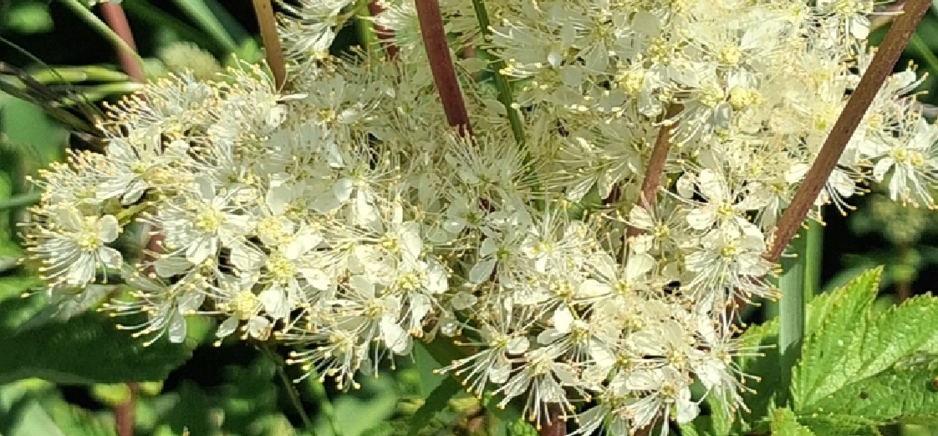
It is only when you pause and examine a flower head closely that you realise you are not looking at one flower at all, but hundreds of tiny blossoms working together.
But more than anything, I look forward to that fragrance.

The scent of freshly cut Meadowsweet is difficult to describe adequately. It is sweet without being overpowering. Delicate yet unmistakable. A fragrance that seems to belong entirely to the Irish summer landscape.
Perhaps that is why our ancestors brought it indoors.
Perhaps that is why it has remained loved for so many centuries.
And perhaps that is why, despite all the modern books, research papers and scientific explanations, I still think of Meadowsweet first as a plant that brings simple pleasure.
Some herbs earn our respect.
Others earn our affection.
Meadowsweet has earned both.
Final Thoughts
Every year, as the first flowers begin to open, I am reminded that some of the most valuable plants are often growing quietly along the roadsides we pass every day.
Meadowsweet asks for little attention.

It simply flowers, perfumes the air, supports pollinators, and continues a relationship with people that stretches back hundreds of years.
For me, it remains one of the true treasures of the Irish summer.
And each year, when that familiar fragrance drifts across a meadow or roadside verge, I know summer has truly arrived.
I hope you feel inspired. Look after your body, and it will keep you healthy.
Catherine

CWD | 24 June 2026 | Ireland
Holistic Healthcare Wexford
Integrative · Mindful · Patient-Centred
About the Author
Dr Catherine W. Dunne MSc.D. is a Registered General Nurse with over 37 years of clinical experience in primary care in Ireland. Alongside her work in General Practice Nursing, she is the founder of Holistic Healthcare Wexford and co-founder of Aumvedas Academy.
With a background that bridges conventional medicine and holistic practice, Catherine has a particular interest in the area where patients are often told “everything is normal,” yet still feel unwell. Her work focuses on helping people understand what their body is communicating, especially in relation to energy, stress, metabolic function, and recovery.
Through a combination of clinical knowledge and holistic support, she works with individuals to restore balance, improve resilience, and support long-term wellbeing.
Based in Wexford, Ireland.
Disclaimer
This article is for informational and educational purposes only and is not intended as medical advice. It does not replace consultation with a qualified healthcare professional. Patients should always seek appropriate medical guidance regarding their individual health needs and before making changes to treatment or care.
 Holistic Healthcare Wexford